Impinj o NXP per i tag RFID per la lavanderia? Cosa conta davvero
When developing or selecting an RFID laundry tag, the choice of IC inevitably comes up. But RFID IC selection cannot be based on datasheet specifications alone.
Impinj and NXP are two established suppliers of RAIN RFID tag ICs, and both offer high-performance options used across item-level RFID applications. Today, Impinj’s M800 series and NXP’s UCODE family represent two important technology paths available to RFID tag designers.
It is tempting to compare them by looking at a few numbers on a datasheet—read sensitivity, memory size or write speed—and conclude that one IC is better than another.
For laundry RFID, the answer is rarely that simple.
An RFID IC does not operate independently. Its real-world performance depends on the antenna, tag construction, textile material, reader infrastructure and the conditions at each reading point.
So rather than asking which brand makes the “better” IC, a more useful question is:
Which IC characteristics actually matter when the finished tag is used in an industrial laundry operation?
The IC Landscape Has Changed
For many years, IC selection for general-purpose UHF RFID tags was centered around established platforms such as the Impinj Monza series and NXP UCODE family.
The latest generations have pushed RF performance further.
Impinj’s M800 series currently includes the M830 and M850. Both offer -25.5 dBm specified read sensitivity and support Impinj Gen2X in addition to standard RAIN RFID / GS1 Gen2v2 operation. The main memory difference is that M830 provides 128-bit EPC memory with no user memory, while M850 provides 96-bit EPC plus 32-bit user memory.
On the NXP side, UCODE 9 and UCODE 9xe remain established high-performance platforms. Both offer -24 dBm specified read sensitivity. UCODE 9xe expands EPC memory from 96 bits to 128 bits while retaining the same RF performance as UCODE 9.
The newer UCODE X moves RF performance further, with NXP specifying -26.2 dBm read sensitivity and -23 dBm write sensitivity, together with flexible EPC/user memory configuration.
On paper, these differences are easy to compare.
| IC | Read Sensitivity | Memory Characteristics | Notable Features |
|---|---|---|---|
| Impinj M830 | -25.5 dBm | 128-bit EPC | Gen2X, AutoTune V3 |
| Impinj M850 | -25.5 dBm | 96-bit EPC + 32-bit user | Gen2X, AutoTune V3 |
| NXP UCODE 9 | -24 dBm | 96-bit EPC | Self-adjust, mature platform |
| NXP UCODE 9xe | -24 dBm | 128-bit EPC | Same RF performance as UCODE 9 |
| NXP UCODE X | -26.2 dBm | Flexible EPC/user memory | Higher sensitivity, fast encoding |
But a laundry operator does not use an IC.
They use a finished RFID laundry tag inside a complete RFID system.
That distinction changes how these specifications should be interpreted.
Higher IC Sensitivity Does Not Automatically Mean a Better Laundry Tag
Read sensitivity is usually the first specification people compare.
A more sensitive IC requires less received RF power to become operational. In principle, that can provide greater read range, support smaller antennas or give the tag more RF margin under difficult conditions.
All of these are useful.
But the relationship is not:
better sensitivity = proportionally longer read range = better laundry tag.
The IC is only one part of the RF design.
The antenna determines how effectively RF energy is captured and transferred to the IC. Its geometry, impedance matching, operating bandwidth and interaction with surrounding materials can significantly influence finished-tag performance.
Laundry tags introduce additional variables.
They may be sewn into linen, inserted into a hem, heat-sealed onto textiles or integrated into garments. They may be folded together with the textile, compressed into stacks or surrounded by wet linen. Their orientation relative to the reader antenna is rarely controlled.
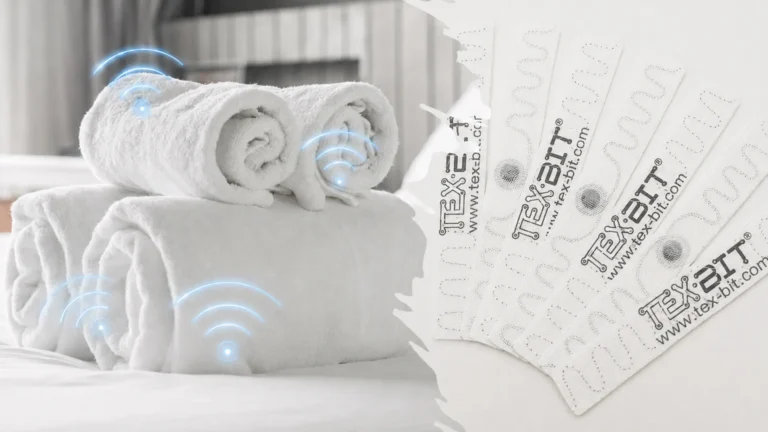
A well-developed Etichetta RFID per lavanderia based on a mature IC can therefore outperform a tag using a newer and more sensitive IC if the latter has not been properly optimized as a complete design.
For laundry RFID, higher IC sensitivity should be viewed as additional engineering margin rather than a guarantee of better tag performance.
That margin can nevertheless be valuable.
It may allow a designer to reduce antenna dimensions, improve performance at difficult orientations, compensate for losses introduced by tag packaging, or create more tolerance for challenging textile environments.
The benefit must ultimately be demonstrated at finished-tag level.
The Laundry Environment Changes the RF Problem
Commercial laundry operations are particularly useful for understanding why datasheet comparisons have limits.
A laundry tag does not remain in one controlled RF environment throughout its life.
The same tag may be read while textiles are soiled, wet, loosely piled, tightly packed, folded, moving on a conveyor or stored as clean inventory.
Consider several typical read points.
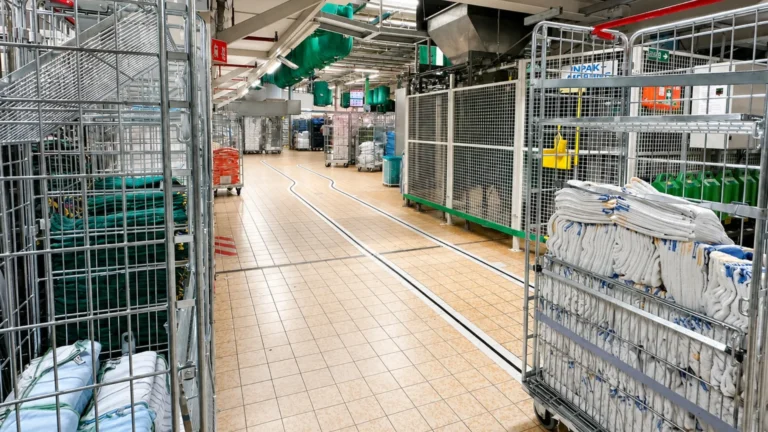
Soiled Linen Receiving
Incoming textiles may arrive in bags, carts or large piles.
Tags can be densely packed with unpredictable orientation, and textiles may contain significant moisture.
Under these conditions, the challenge is not achieving the maximum possible read distance from an isolated tag.
The system needs sufficient RF margin and a well-designed read zone to identify a large, irregular tag population reliably.
Ordinamento
Automated or semi-automated sorting introduces a different requirement.
Items may move through a defined read point at speed. The available reading time becomes shorter, and reliable inventory performance becomes increasingly important.
Here, both tag performance and reader-side capabilities can affect the result.
Clean Linen Inventory
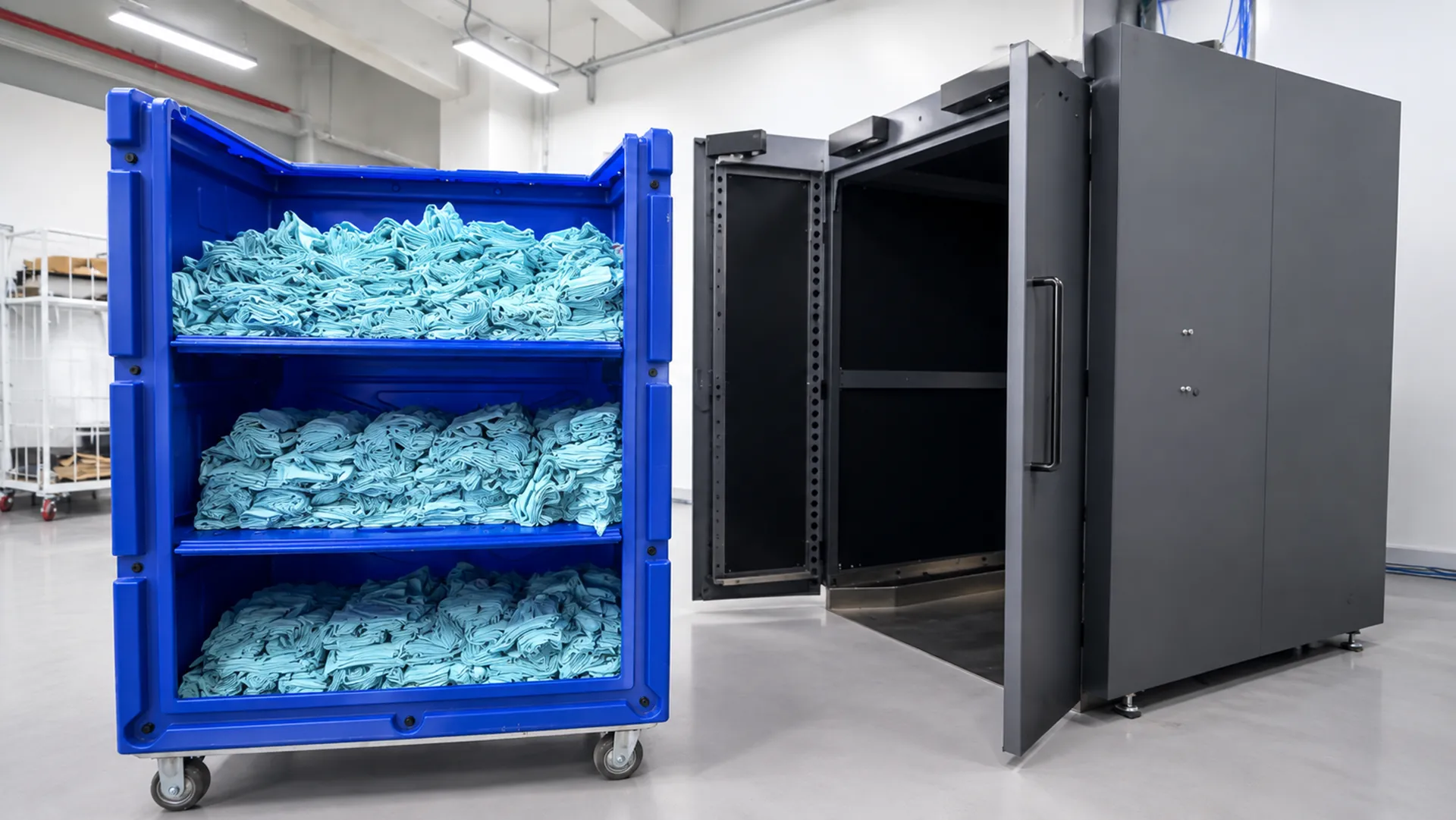
After washing and finishing, textiles may be folded and densely stacked.
The environment is cleaner and more predictable, but tag orientation and stacking can still create RF challenges.
Again, consistency across the entire stack is usually more valuable than exceptional peak read distance from one optimally positioned tag.
Handheld Reading
Handheld inventory creates yet another RF environment.
Reader position, distance and orientation continuously change. The human body and surrounding textile mass can also influence RF propagation.
A tag that performs exceptionally in a fixed-reader tunnel does not necessarily deliver the same relative advantage during handheld inventory.
This is why IC selection for laundry applications should be evaluated against actual operational read points, rather than a single laboratory read-range result.
Where M800 and Gen2X Can Make a Difference
The Impinj M800 series introduces an additional consideration because its capabilities extend beyond conventional IC sensitivity.
M830 and M850 remain compliant with the standard RAIN RFID air interface, so tags based on them can operate with standard compliant readers. At the same time, they support Impinj Gen2X.
With compatible infrastructure, Gen2X introduces performance enhancements affecting areas such as tag readability, inventory speed, tag filtering and communication between the reader and tag.
This distinction matters.
In conventional thinking, improving tag readability often focuses primarily on the forward link—the reader delivering enough energy to activate the IC.
But a successful read also requires the tag’s response to be received and decoded reliably by the reader.
Gen2X addresses aspects of this system-level communication.
For a laundry application involving dense tag populations or high-throughput read points, this could create meaningful advantages.
However, there is an important qualification:
The value of Gen2X depends on the reader infrastructure and the way the laundry system is designed.
If a laundry uses standard Gen2 infrastructure without Gen2X support, an M830 or M850 tag can still operate normally and benefit from the IC’s underlying RF characteristics. But the system will not automatically gain all of the additional Gen2X performance capabilities.
Therefore, selecting M800 simply because it supports Gen2X makes little sense unless the reader environment and future system architecture are also considered.
This is a good example of why laundry RFID IC selection is increasingly a system decision, not just a tag decision.
Where UCODE 9 Still Makes Sense
Newer does not automatically mean necessary.
UCODE 9 has become a mature platform with -24 dBm specified sensitivity, and numerous tag and antenna designs have already been developed around it.
That maturity has practical value.
For an existing laundry tag design that already provides the required read performance, durability and production stability, moving to another IC solely because its datasheet shows higher sensitivity may create little operational benefit.
Changing an IC can require antenna re-evaluation, performance testing and production validation. For a laundry tag, repeated wash testing and application-level testing may also be required before a new configuration can be considered equivalent to the existing product.
If the existing tag already provides sufficient system margin, the technically correct decision may be to leave it unchanged.
This leads to an important principle:
An IC upgrade is valuable only when it solves an actual performance or design constraint.
Does UCODE 9xe’s Additional Memory Matter in Laundry?
UCODE 9xe illustrates another common issue in IC selection.
It provides 128-bit EPC memory instead of the 96-bit EPC configuration of UCODE 9, while maintaining the same specified RF performance.
Is that better for laundry?
Not necessarily.
In many linen-management systems, the tag primarily provides a unique identity. Information such as item type, customer ownership, wash history, circulation count, location and lifecycle status is maintained in the software platform rather than written repeatedly to the RFID tag.
In such an architecture, additional EPC capacity may provide little operational value.
There are, however, projects where a longer encoding structure is required by an existing identification scheme, integration architecture or customer specification. In those cases, 128-bit EPC memory can become a legitimate selection factor.
The decision should therefore be driven by the data architecture.
Do not select more tag memory simply because more memory is available.
For most laundry systems, the more important question is whether the tag can be identified reliably at every required process point.
What Does UCODE X Change?
The introduction of UCODE X makes the comparison more interesting.
With a specified read sensitivity of -26.2 dBm, it provides substantially more RF margin than earlier UCODE generations on paper. It also offers improved write sensitivity, faster encoding and flexible memory allocation.
For laundry tag engineering, the most interesting aspect is not simply the number itself.
The real question is what that additional RF margin allows the tag designer to do.
Potentially, it can be used to:
- improve readability within an existing tag form factor;
- reduce antenna dimensions;
- compensate for RF losses introduced by packaging;
- improve performance under less favorable tag orientations;
- provide additional design margin across different operating frequencies.
But each of these possibilities requires validation.
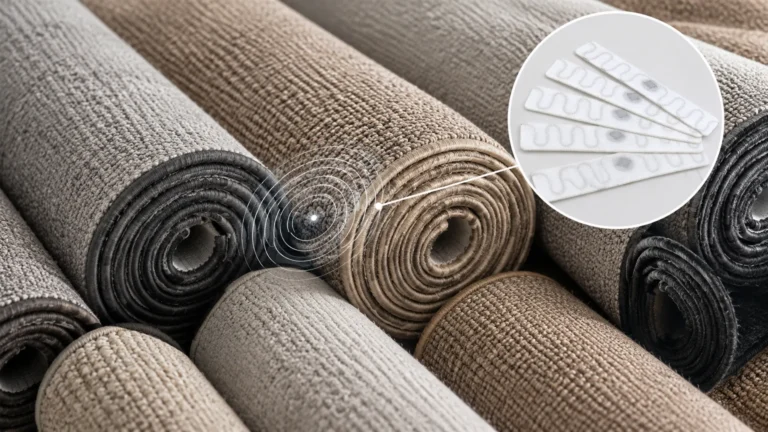
Laundry tags have relatively unusual mechanical and material constraints compared with disposable retail labels. Antenna construction must survive repeated flexing and processing, while encapsulation and attachment methods influence the RF design.
Moving from UCODE 9 to UCODE X therefore should not be treated as a simple chip substitution.
The relevant question is:
Can the new IC enable a measurably better laundry tag or solve a constraint that the existing design cannot?
If the answer is yes, redesign and validation may be worthwhile.
If the existing tag already exceeds the application’s performance requirements, the additional IC capability may provide limited practical return.
Laundry Durability Is Not an IC Specification
There is another important distinction that is sometimes lost when comparing RFID ICs.
Neither Impinj nor NXP determines whether a finished laundry tag will survive an industrial wash process simply through the IC specification.
Laundry durability comes primarily from the complete tag construction.
This includes:
- chip-to-antenna bonding;
- antenna material and structure;
- encapsulation;
- sealing;
- mechanical protection;
- attachment method;
- resistance to heat, pressure and chemicals.
An IC with excellent RF performance can still become part of an unreliable laundry tag if the antenna connection or encapsulation fails after repeated washing.
Likewise, a durable tag must maintain not only physical integrity but also stable RF performance over its intended service life.
For this reason, wash-cycle testing and RF testing should not be treated as separate topics.
A tag that remains physically intact after repeated washing but loses significant read performance has not fully met the requirement.
For industrial laundry, RF stability over the tag lifecycle matters more than the IC specification on day one.
So Which IC Should a Laundry RFID Tag Use?
There is no useful universal answer such as “choose Impinj for this application” or “choose NXP for that application.”
A better selection process starts with the requirements of the finished tag and system.
When a Mature IC Platform Already Meets the Requirement
If an existing UCODE 9 or established Impinj-based laundry tag provides sufficient read margin, stable manufacturing and proven wash durability, there may be little reason to change it.
Maturity itself has value.
When More RF Margin Is Needed
If a project requires a smaller tag, faces difficult read conditions or needs greater design margin, newer high-sensitivity ICs such as M830/M850 or UCODE X become particularly interesting.
The finished tag should still be redesigned or validated around the new IC rather than assuming that the datasheet improvement will transfer directly into application performance.
When Gen2X Infrastructure Is Part of the System
Where compatible reader infrastructure is deployed and dense-population or high-throughput reading is important, the M800 series deserves evaluation not only as an IC but as part of the wider Gen2X-enabled system.
When EPC or User Memory Requirements Are Different
Memory requirements can narrow the choice between M830, M850, UCODE 9, UCODE 9xe and newer configurable-memory options.
But memory should follow the application’s data model rather than drive it.
When an Existing Laundry System Is Being Upgraded
Compatibility with installed readers, antennas, software and established read zones should be evaluated before changing the tag IC.
An IC with a stronger datasheet specification does not justify destabilizing a proven system unless it produces a meaningful operational improvement.
Test the Tag, Not Just the Chip
The most reliable way to choose between Impinj and NXP for a laundry RFID project is ultimately empirical.
Build representative tag designs and test them under the conditions that matter.
In our own RFID tag development and evaluation work, we conduct comparative IC and tag performance testing under controlled conditions, including evaluations across different IC generations and configurations. These tests help us understand how differences observed at IC level translate into finished-tag performance and system behavior.
That means going beyond a single free-air read-range test.
A meaningful laundry RFID evaluation should consider:
- dry and wet textiles;
- different linen and garment materials;
- realistic tag attachment positions;
- folded and stacked textiles;
- random tag orientations;
- bulk tag populations;
- fixed and handheld readers where applicable;
- actual operating frequency regions;
- relevant laundry process read points;
- RF performance before and after repeated wash cycles.
The objective is not to identify which IC wins a laboratory comparison.
This is also why textile RFID performance must be evaluated at system level, rather than through individual component specifications alone.
The objective is to determine which finished tag provides sufficient and repeatable performance margin within the intended laundry system.
What Really Matters
Impinj and NXP continue to advance RAIN RFID IC performance in different ways.
The Impinj M800 series combines strong IC-level sensitivity with Gen2X capabilities that can extend performance into the reader and system environment. NXP’s UCODE 9 and 9xe remain mature high-performance platforms, while UCODE X introduces another significant step in RF sensitivity and design flexibility.
These differences matter.
But in industrial laundry, they matter only in the context of the complete tag and the complete system.
A 1 or 2 dB improvement on an IC datasheet can create useful engineering margin. It may help reduce tag size or improve difficult reads. But it cannot correct a poorly matched antenna, an unsuitable tag construction or an incorrectly designed read point.
Likewise, advanced protocol features create value only when the surrounding infrastructure can use them.
For RFID laundry tags, the right question is therefore not: “Is Impinj better than NXP?”
It is: “Which IC gives this tag design and this laundry system the performance margin they actually need?”
That is where meaningful RFID IC selection begins.
Developing an RFID Laundry Project?
Talk with us about RFID tag performance, reader deployment and textile application requirements.