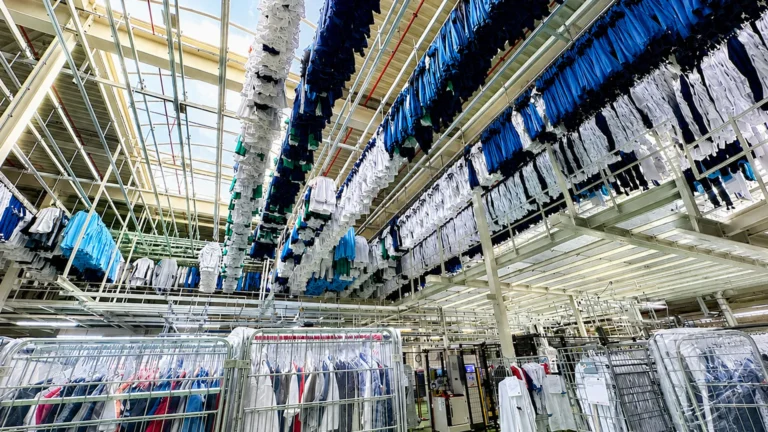
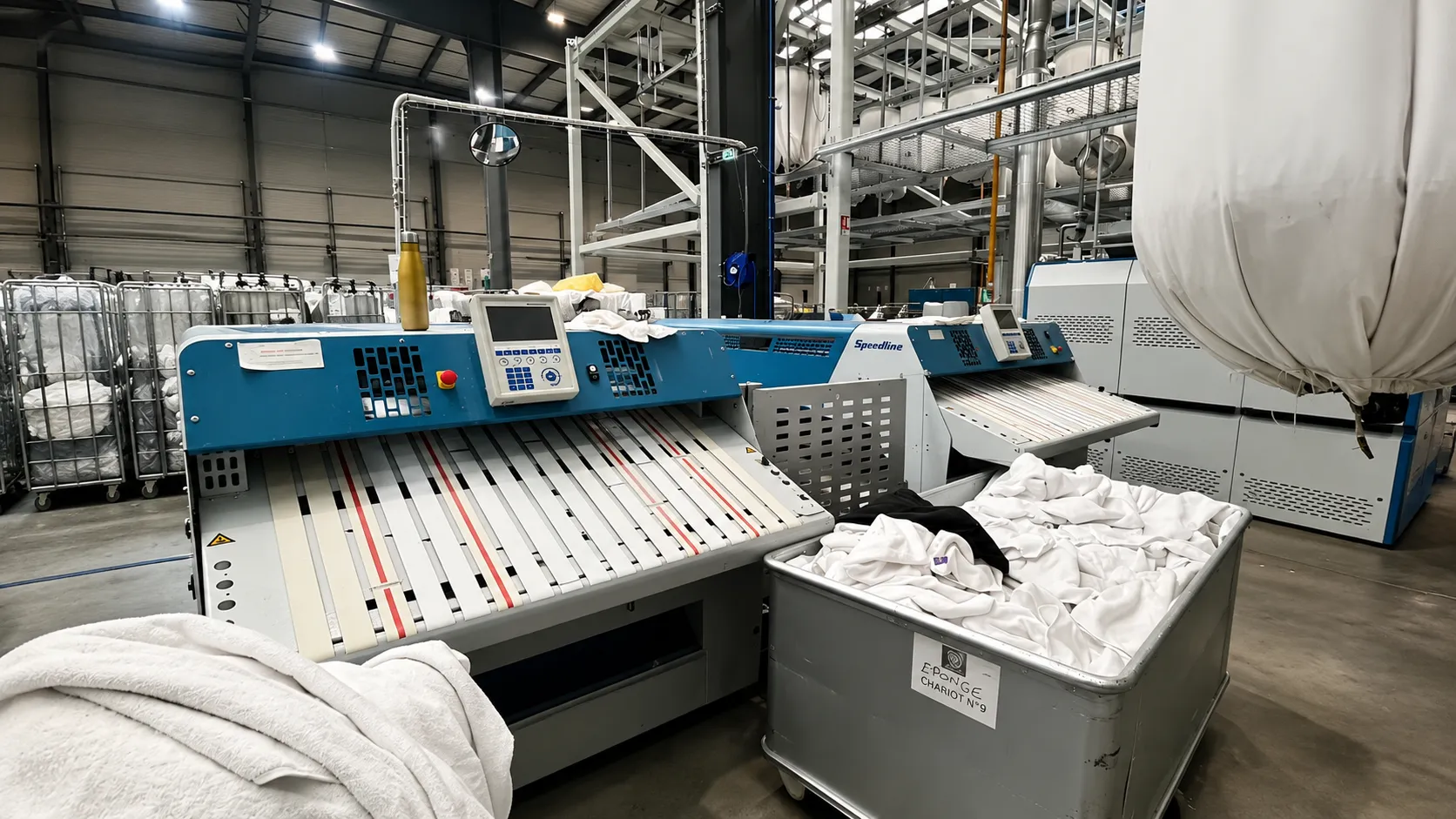
How to Evaluate RFID Laundry Tags for Industrial Laundry Applications
Choosing an RFID laundry tag for industrial laundry applications can appear straightforward. Most RFID linen tags have a relatively similar appearance, and many products offer comparable basic specifications, such as UHF RFID technology, washable construction, different dimensions, and stated laundry-cycle performance.
However, the differences that matter in long-term operation are often less visible.
For an industrial laundry, textile rental company, hotel group, or other textile-service operation, an RFID laundry tag needs to withstand repeated processing while continuing to provide reliable identification. Over time, its performance may change. The important question is not whether the tag remains exactly the same as when it was new, but whether its performance remains sufficiently stable and within an acceptable range throughout its intended service life.
This makes RFID laundry tag evaluation less about finding the highest number on a specification sheet and more about understanding durability, installation, RF performance, consistency, and stability under repeated use.
At TEX-BIT, this perspective has been shaped by our own RFID laundry tag development and manufacturing, as well as by customer communication, project experience, cooperation with industry partners, and observations from actual laundry operations.
1. Start with the Actual Requirements of the Laundry Operation
Before comparing RFID laundry tags, it is useful to understand what the tag will actually experience throughout its service life.
Relevant factors may include:
- The type of textile
- How the tag will be installed
- The washing, drying and finishing processes
- Frequency of processing
- Expected service life
- The different points at which the tag will be read
- Whether textiles are read individually or in bulk at different stages of the operation
- Changes in textile condition throughout processing, such as wet, dry, folded or stacked states
- Whether textiles are stationary or moving during different reading processes
These conditions provide the context for evaluating the tag.
A well-developed RFID linen tag can be suitable for a broad range of textile-service applications. The question is therefore not necessarily which tag shape is designed for each individual application, but whether the selected product can maintain appropriate performance under the conditions it will actually encounter.
Understanding those conditions should ideally begin before product testing.
Customer discussions and project experience can reveal practical requirements that may not be obvious from a product specification. Visits to laundry facilities can provide another perspective, helping to identify how textiles are actually processed, handled, installed, and read.
These observations can then be translated into specific product and testing requirements.
In this sense, evaluating a laundry tag starts with understanding the operation, rather than starting with a number on a datasheet.
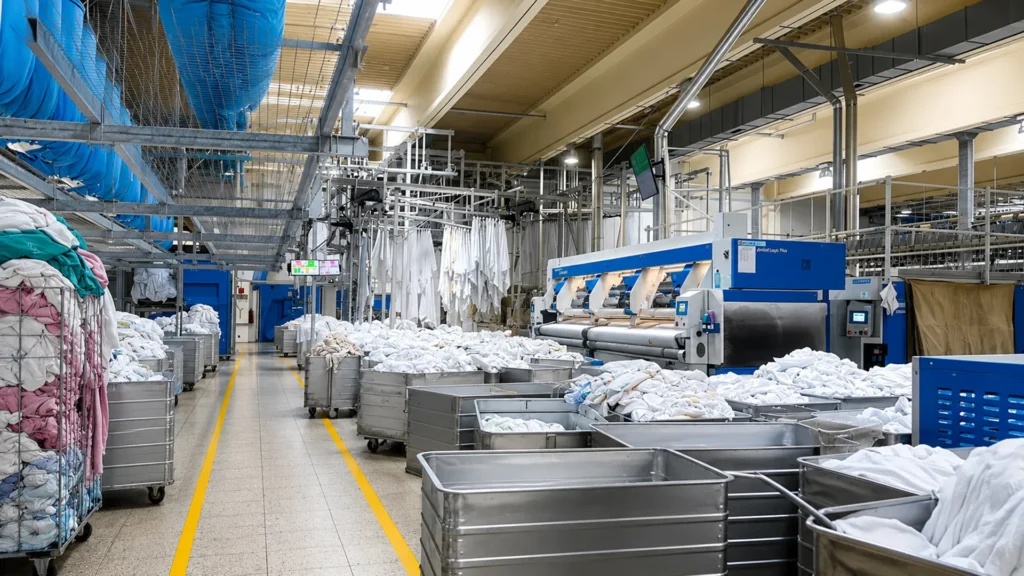
2. Look Beyond the Number of Wash Cycles
A stated number of laundry cycles is one of the easiest specifications to compare.
However, the number alone does not describe how an RFID laundry tag will perform throughout its service life.
Repeated industrial processing can expose a tag to a combination of:
- Washing and rinsing
- Chemicals
- Mechanical pressure and extraction
- Drying
- Finishing processes
- Folding and bending
- Repeated handling
These conditions can affect both the physical structure of the tag and its RF performance.
A tag may remain physically intact while its RF characteristics gradually change. Therefore, durability should not be evaluated only by checking whether the tag is still physically usable after a certain number of cycles.
A more meaningful evaluation considers how the tag changes during repeated processing.
At TEX-BIT, RFID laundry tag development involves multiple rounds of comparative testing. Different product designs and configurations are evaluated under relevant conditions before a solution is selected. Production products are also subjected to simulated testing to verify that the developed design continues to perform as expected.
The objective is not simply to pursue the highest possible wash-cycle figure.
It is to understand how the product behaves as repeated processing continues.
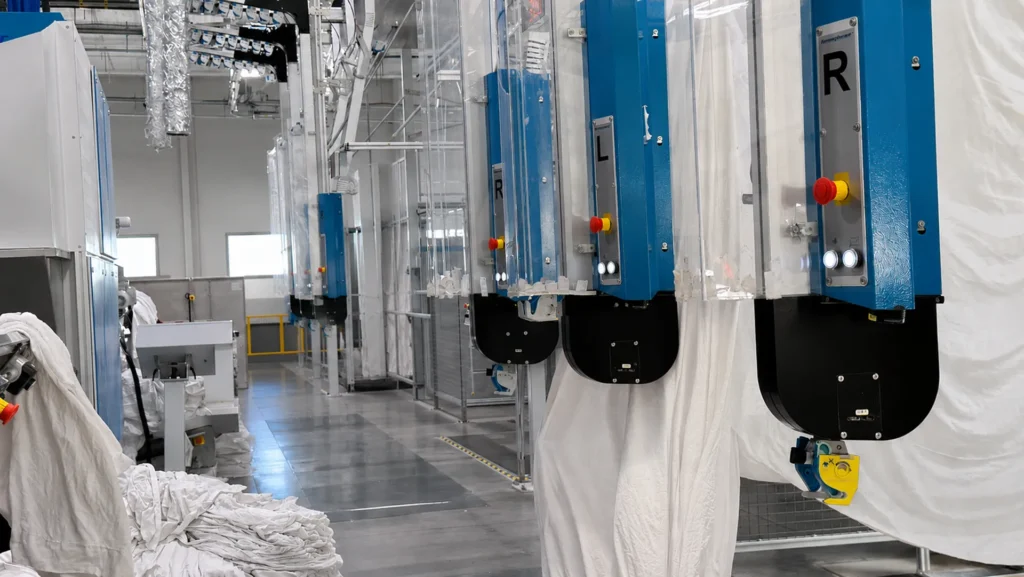
3. Evaluate RF Performance Before and After Repeated Washing
Durability and RF performance should be considered together.
A tag can remain physically intact after repeated washing while its RF performance changes. For this reason, checking only whether a tag can still be read after durability testing does not provide the complete picture.
When evaluating samples, it is useful to compare RF performance before and after repeated processing.
This can help identify:
- Whether RF performance changes
- The degree of performance degradation
- Whether the change is gradual or significant
- Whether different samples show broadly similar behavior
- Whether the remaining performance is still sufficient for the intended application
Some degree of RF performance degradation after repeated washing and use is normal. An RFID laundry tag should not be expected to maintain exactly the same RF performance throughout its entire service life.
The more practical objective is:
Performance degradation should remain within an acceptable range, while unnecessary performance loss should be minimized.
This distinction is important when evaluating long-term performance.
A tag with strong initial RF performance may not necessarily provide the best long-term result if its performance changes significantly during repeated processing. A product with sufficient initial performance and more controlled degradation may ultimately be more suitable for an industrial laundry environment.
4. Evaluate RF Performance Stability Over Time
Peak RF performance is only one part of RFID tag evaluation.
In an industrial laundry environment, a more useful question is whether the tag can maintain sufficiently stable RF performance as its condition changes through repeated processing and use.
During a typical textile-service process, the same RFID tag may experience different conditions throughout its service life. Its physical condition can change as it goes through washing, drying, finishing, handling and repeated use.
The objective is therefore not to expect the RF performance to remain completely unchanged.
Instead, the focus should be on whether performance changes remain gradual, controlled and within an acceptable range.
This is also why a single RF measurement should not be treated as representative of the entire product.
During product development, multiple samples and configurations can be compared to understand the range of RF performance and how it changes under relevant conditions. Repeated testing provides a better basis for evaluating stability than relying on one peak measurement.
For long-term industrial use, a predictable change in performance is generally more meaningful than a strong initial result followed by significant deterioration.
5. Understand What Consistency Really Means
Consistency is particularly relevant when RFID laundry tags are produced and deployed in large quantities.
However, consistency does not mean that every individual tag will produce exactly the same test result.
Some variation between individual products is normal in mass production.
What matters is whether the overall performance remains within a stable and controlled range.
When evaluating a product, this can be considered across:
- Multiple samples
- Repeated tests
- Different production batches where appropriate
- Performance before and after durability testing
Looking at multiple samples provides a more realistic understanding of product behavior than relying on a single successful unit.
For TEX-BIT, consistency means maintaining product performance within an appropriate and predictable range, rather than claiming that every tag performs identically.
This is one reason why comparative testing and production-product validation are important parts of our development process.
6. Consider the Installation Method
An RFID laundry tag does not operate independently once it has been installed.
It becomes part of the textile and goes through the same washing, drying, handling, and finishing processes.
Therefore, long-term evaluation should consider the combination of:
Tag + Installation + Textile
The installation method can affect:
- Mechanical stress
- Bending and folding
- Physical protection
- Tag positioning
- Long-term integrity
- RF performance
For many textile-service applications, the same RFID linen tag design can be used across different textile categories. The important point is to ensure that the installation method is appropriate and that the tag continues to perform after it has been installed.
This is particularly relevant when evaluating samples. Testing the tag separately may provide useful product-level information, but testing an installed tag on a representative textile can provide a more meaningful indication of its behavior in actual use.
7. Evaluate RFID Reading Performance at Actual Reading Points
Laboratory testing can help establish the RF performance of an RFID laundry tag, but the final application involves more than the tag itself.
During an industrial laundry process, the same RFID tag may pass through several reading points. At different stages, textiles may be wet or dry, loose or folded, individually handled or processed in larger quantities. Some reading points may involve stationary textiles, while others may involve tags moving through a conveyor or automated reading area.
These conditions can influence the actual reading result.
Therefore, application testing should focus on whether the tag can provide reliable identification at the reading points that matter to the operation.
The relevant question is not simply:
“How far can this tag be read?”
It is:
“Can this tag provide reliable identification at the reading points that matter to the operation?”
At TEX-BIT, application-related RF and reading tests form part of our broader product evaluation process. The conditions considered in testing are informed by customer requirements, project experience, and observations from actual laundry facilities.
This helps connect product-level RF evaluation with the conditions in which the tag will actually be used.
In practice, the tag is only one part of the reading process. Reader performance, antenna configuration, tag orientation, textile condition, tag quantity and the physical layout of the reading point can all influence the final result. This is also why successful textile RFID deployment requires attention to the interaction between the tag and the wider operating environment, as discussed in Why Textile RFID Systems Fail.
8. Look Beyond the Appearance and the RFID IC
RFID linen tags from different manufacturers can look very similar. Their dimensions may be close, and they may even use the same or comparable RFID IC platforms.
However, similar appearance or the same IC does not necessarily mean equivalent long-term performance.
The performance of a finished RFID laundry tag is influenced by its complete construction and manufacturing process, including:
IC + Antenna + Bonding + Protection + Mechanical Construction + Manufacturing
The RFID IC is an important component, but it does not determine the performance of the finished laundry tag on its own.
The choice of IC, antenna design, bonding process, protection, mechanical structure, and manufacturing process all contribute to the final result. This is why RFID IC selection for laundry tags needs to be considered together with the finished tag design rather than evaluated independently.
At TEX-BIT, RFID laundry tags are developed and manufactured within our own organization. This allows product design, testing, manufacturing experience, and production feedback to remain closely connected throughout the development process.
Our product development is also informed by practical application requirements.
Customer communication, project feedback, cooperation with industry partners, and observations from laundry facilities help us identify the conditions and problems that deserve further evaluation. These inputs are brought into product development and translated into targeted comparative testing.
Different designs and configurations can then be evaluated through multiple rounds of testing, followed by simulated testing of production products and application validation.
This creates a continuous connection between:
Real Application Requirements → Product Development → Comparative Testing → Production Validation → Application Feedback
This connection is an important part of how we approach RFID laundry tag development.
9. Consider Reliability Together with Unit Price
For large-scale laundry operations, unit price naturally matters.
However, the lowest initial price does not necessarily result in the lowest overall operating cost.
If a tag provides unstable performance or degrades faster than expected, additional costs may arise from:
- Manual checking
- Tag replacement
- Troubleshooting
- Additional handling
- Operational interruptions
- Reduced confidence in RFID records
This does not mean that a higher-priced tag is automatically better.
The more useful comparison is whether the product provides an appropriate balance between cost, durability, RF performance, stability, and expected service life.
A lower-cost product may be attractive at the purchasing stage, but if its performance creates additional operational problems later, the initial price advantage may no longer be meaningful.
For long-term textile-service operations, reliable and predictable performance can be more valuable than simply minimizing the purchase price.
10. A Practical Checklist for Evaluating RFID Laundry Tags
When evaluating RFID laundry tags for an industrial application, the following questions can provide a practical starting point.
Durability
- Has the tag been evaluated under conditions relevant to the intended laundry process?
- How does the tag change after repeated processing?
- Does the physical construction remain suitable for continued use?
RF Performance
- What is the initial RF performance?
- Has RF performance been evaluated again after repeated washing?
- How much performance degradation occurs?
Stability
- Does RF performance remain sufficiently stable during repeated use?
- Is any degradation within an acceptable range?
- Is there sufficient RF performance margin for the intended reading process?
Consistency
- Have multiple samples been evaluated?
- Is variation between samples reasonably controlled?
- Does the overall product performance remain predictable?
Installation
- How will the tag be installed?
- Has the installed tag been evaluated on representative textiles?
- Could the installation method introduce additional mechanical stress?
Reading Performance
- Have the different reading points in the laundry process been considered?
- Will tags be read individually or together with many other tags at different stages?
- How does textile condition change throughout the process, such as from wet to dry or from loose to folded and stacked?
- Have the relevant reader and antenna configurations been considered?
Long-Term Value
- Is the product cost reasonable relative to its expected service performance?
- Could a lower initial price result in additional replacement or operational costs?
These questions do not require every project to follow exactly the same testing procedure. The appropriate evaluation should reflect the actual application and the conditions the RFID laundry tag is expected to face.
11. Look at Long-Term Experience in Real Laundry Applications
Laboratory testing is important, but long-term experience in real laundry applications provides another valuable perspective.
TEX-BIT has focused on RFID applications for industrial laundry and textile services in Central Europe and North America for nearly ten years. During this period, our RFID laundry tags have been deployed in large-scale textile-service operations, with approximately 30 million tags supplied annually.
Over these years, continued customer and project feedback has been an important part of our product development and validation process. To date, we have not received customer complaints related to the performance of our RFID laundry tags.
This does not mean that RFID laundry tags never change in performance during their service life. As discussed throughout this article, repeated washing and use can naturally lead to some degree of performance degradation. What matters is whether the product continues to perform reliably within the conditions for which it was designed.
For customers evaluating RFID laundry tags, long-term application experience can therefore be an important part of the decision—not as a replacement for testing, but as additional evidence of how a product performs beyond the laboratory.
With nearly a decade of experience focused on Central European and North American laundry markets, TEX-BIT brings together product development, manufacturing, testing and practical application experience in RFID laundry tags.
For laundry operators and textile-service companies looking for a proven RFID laundry tag for long-term deployment, this experience provides a practical basis for choosing a product that has already been used at significant scale.
Conclusion: Look Beyond the Initial Specification
An RFID laundry tag should not be evaluated only by how it performs when new.
For industrial laundry applications, the more meaningful consideration is how its performance changes through repeated washing and use—and whether those changes remain within an acceptable range.
At TEX-BIT, our approach is shaped by product development, manufacturing experience, customer requirements, project feedback, and observations from actual laundry operations.
With nearly ten years of focus on RFID for laundry and textile services in Central Europe and North America, and approximately 30 million RFID laundry tags supplied annually, our products have accumulated extensive real-world application experience.
The real value of a laundry tag is not only how it performs when new, but how reliably it continues to perform over time.
For customers looking for an RFID laundry tag for long-term industrial use, proven application experience is one of the factors worth considering alongside product performance and testing.
Evaluating RFID Laundry Tags?
Test TEX-BIT RFID laundry tags under your actual operating conditions. Samples are available for application and performance evaluation.