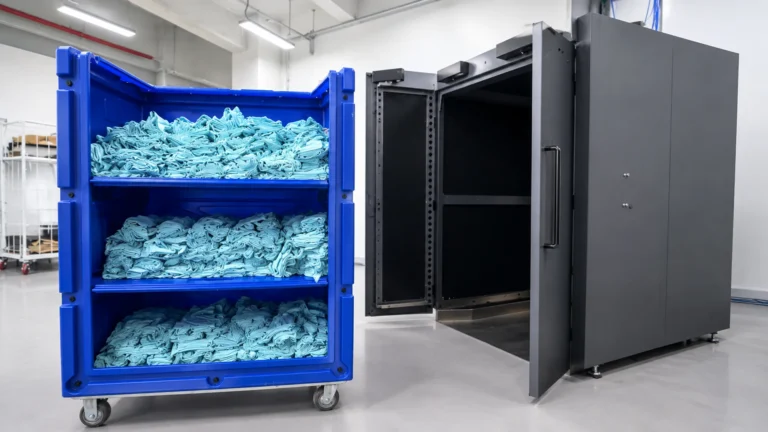

How UHF RFID Laundry Tags for Uniform Rental Improve Garment Control
UHF RFID laundry tags for uniform rental can provide more reliable records of garment assignment, issue and return, laundry processing, clean-stock availability, and movement between the laundry and customer sites.
Uniform rental providers manage workwear through a recurring service cycle. Garments are assigned or distributed to wearers, used at customer sites, collected as soiled workwear, transported to the laundry, received and classified, washed and finished, inspected or repaired, returned to clean stock, and prepared for redistribution.
At any given time, uniforms may be assigned to individual wearers, held in a size-based garment pool, stored in a uniform room or distribution cabinet, in use, awaiting soiled-garment collection, in transit, moving through laundry production, undergoing repair, or removed from service.
When these movements depend mainly on manual records, barcode scans, or visual identification, it can be difficult to maintain accurate wearer balances, customer stock records, and garment histories.
UHF RFID laundry tags for uniform rental provide each garment with a unique digital identity. When tagged garments pass through defined read points, the system can create more consistent transaction records across garment issue, return, laundry receiving, processing, clean-stock storage, and redistribution.
Why Uniform Rental Requires Better Garment Visibility
Uniform rental is more complex than counting the total number of garments in circulation. Providers must also understand who or which customer holds each garment, whether the correct sizes and garment types are available, and where shortages or processing delays occur.
Garments Move Across Multiple Control Points
A rented uniform may move between a laundry facility, transport vehicle, customer site, uniform room, smart cabinet, employee locker, workplace, soiled-garment collection point, and repair area.
Each handover changes the garment’s operational status. However, not every movement is automatically reflected in a central record.
A provider may know how many garments were originally placed into service but still lack a reliable view of how many are currently assigned, awaiting return, undergoing processing, available as clean stock, or unavailable because of repair or retirement.
Different Assignment Models Create Different Requirements
Some uniform programs assign specific garments to individual employees. This is common where garments are personalized, size-specific, role-specific, or subject to hygiene and safety requirements.
Other programs operate with pooled garments. Employees receive an available garment of the correct type and size rather than a personally assigned item.
RFID can support both models, but the required records are different. Individually assigned garments require clear wearer issue and return transactions, while pooled garments place greater emphasis on size availability, clean-stock levels, and distribution control.
The software and reading process should therefore reflect the actual rental model rather than applying the same workflow to every customer.
Manual Issue and Return Records Create Gaps
Without automated identification, garment issue and return may depend on handwritten records, employee declarations, barcode scans, or periodic stock counts.
Missing transactions can make it difficult to determine whether a garment is still with a wearer, has been placed in a soiled-garment return unit, is moving through laundry production, or has been lost or removed from service.
These gaps can lead to repeated recounting, unnecessary replacement purchases, insufficient stock in particular sizes, and uncertainty when employees leave or change roles.
How UHF RFID Laundry Tags for Uniform Rental Support Operations
A uniform RFID solution normally combines washable UHF RFID tags, reader devices and antennas, and software or an RFID platform that converts tag reads into garment transactions.
The objective is not to capture every movement continuously. The priority is to record garments at points where assignment, custody, inventory status, or processing status changes.
At Garment Issue and Return
RFID can support garment distribution through uniform rooms, staffed issue counters, smart cabinets, or other controlled distribution points.
When a garment is issued, the system can associate it with a wearer, customer department, site, or garment pool. When the garment is placed into a return unit or collected as soiled workwear, a corresponding return transaction can update its status.
This provides a clearer record of which garments are currently assigned, which have been returned for laundering, and which remain outstanding.
For individually assigned workwear, these records can also support employee onboarding, size changes, role changes, and final garment reconciliation when an employee leaves.
At Laundry Receiving and Processing
When soiled uniforms arrive at the laundry, tagged garments can be identified in batches at inbound receiving. This creates a customer-level record of the garments entering the laundry operation.
The garments can then move through classification, washing, drying, finishing, inspection, repair, and clean-stock preparation.
Additional read points may be used when the operation needs to confirm processing status, create wash-cycle records, or identify garments requiring special handling. However, RFID infrastructure is not required at every production stage.
The priority should be the control points that create useful records and support a defined operational action.
During Clean-Stock Preparation and Redistribution
After processing, clean garments may be returned to wearer-specific sets, size-based stock, customer orders, distribution cabinets, or delivery routes.
RFID can help verify which garments have been allocated before outbound dispatch or cabinet replenishment. This supports more reliable customer deliveries and reduces the risk of sending the wrong garment type, size, or wearer-assigned item.
At the customer site, a receiving or distribution record can confirm that clean uniforms have entered the local garment-management process.
What Better Garment Visibility Can Improve
The value of RFID comes from improving garment control, wearer accountability, stock planning, and lifecycle decisions.
More Reliable Wearer Accountability
For wearer-assigned garments, RFID can create clearer issue and return histories without depending entirely on manual records.
The system can show which garments have been issued to an employee, which have entered the soiled-garment return process, and which remain outstanding.
RFID does not physically prevent garments from leaving a site or being used incorrectly. It provides a more reliable transaction history that makes exceptions easier to identify and investigate.
Stronger Customer–Laundry Reconciliation
Uniform rental providers must reconcile garments collected from customer sites with garments received, processed, and returned as clean stock.
RFID can create more consistent records at collection, laundry receiving, clean-order preparation, dispatch, and customer delivery.
When expected and recorded quantities do not match, the provider can review the relevant transaction rather than relying only on a later physical count.
Over time, these records may reveal recurring variances associated with particular customer sites, departments, delivery routes, garment types, or return procedures.
Better Size and Clean-Stock Availability
Uniform shortages are not always caused by insufficient total inventory. A provider may hold enough garments overall while lacking the sizes or garment types required at a particular customer site.
RFID records can provide a clearer view of clean garments available by customer, garment type, and size, as well as garments assigned to wearers or moving through laundry production.
This helps operations distinguish between a genuine stock shortage and a distribution, collection, or laundry-turnaround issue.
More Useful Garment Lifecycle Records
Uniforms are exposed to repeated use, industrial washing, drying, finishing, and repair. Their service life depends on garment construction, textile type, use conditions, cleaning process, and care requirements.
Consistent RFID records can help providers review wash counts, repair histories, issue frequency, and service duration.
This information can support replacement planning and comparisons between garment categories, customers, or applications. It does not replace physical inspection, but it provides additional evidence when deciding whether a garment should remain in service, be repaired, or be retired.
More Consistent Garment Care
Different garments may require different washing programs, drying conditions, finishing processes, or inspection procedures.
When garment identity is connected to care rules in the software, RFID records can help identify items that require special processing or should not enter a particular production route.
This is especially relevant for specialized workwear, hygiene-sensitive garments, and protective clothing, where incorrect processing may affect garment performance or compliance.
What a Practical Uniform RFID Deployment Requires
Selecting UHF RFID laundry tags for uniform rental involves more than confirming that a tag is washable.
The tag must be suitable for the garment material, tag attachment method, industrial washing conditions, extraction pressure, drying and finishing temperatures, expected service life, and required read performance.
Tag position must also be consistent and suitable for garment use. It should avoid causing discomfort to the wearer, interfering with garment function, or creating unnecessary handling problems during washing and finishing.
Reader configuration must reflect how garments are handled at each control point. Loose garments at an issue counter, garments stacked in a cabinet, and compressed soiled workwear inside bags or carts create different reading environments.
The provider should first define the transaction that needs improvement. This may be wearer issue and return, soiled-garment receiving, clean-stock inventory, cabinet replenishment, outbound order verification, or customer-level reconciliation.
The read point, software rule, and garment-handling procedure should then be designed around that transaction.
A focused initial deployment makes it easier to validate tag performance, reading accuracy, assignment rules, staff procedures, and the value of the resulting records before extending RFID to additional customer sites or garment categories.
When UHF RFID Laundry Tags Are a Good Fit for Uniform Rental
RFID is generally most valuable for uniform rental providers managing large garment volumes, multiple customer locations, wearer-specific assignments, complex size ranges, or substantial manual reconciliation work.
It may be worth evaluating when garments frequently remain unreturned, customer balances are difficult to reconcile, employees require controlled garment issue, clean-stock shortages occur in specific sizes, or existing records do not provide a reliable view of garments in use and moving through laundry production.
RFID can also be valuable where customers require documented garment histories, controlled hygiene processes, or more consistent handling of specialized workwear.
Smaller programs with limited garment volumes, simple distribution processes, and reliable manual controls may not require the same level of RFID infrastructure.
The decision should be based on a clearly defined assignment, inventory, or reconciliation problem rather than on the technology alone.
Conclusion
UHF RFID laundry tags for uniform rental can improve garment assignment records, wearer accountability, customer–laundry reconciliation, clean-stock visibility, and lifecycle planning.
The technology is most effective when reader devices are deployed at clearly defined control points and each read represents a meaningful transaction, such as garment issue, soiled-garment return, laundry receiving, clean-stock preparation, or customer delivery.
Uniform rental providers do not need to record every garment movement continuously to gain value from RFID. A practical project can begin with the assignment or reconciliation process that currently creates the greatest operational difficulty.
When tag performance, reader configuration, software rules, and garment-handling procedures are properly aligned, RFID can provide a more reliable foundation for managing uniforms throughout their service life.
Improve Control Across the Uniform Cycle
Tell us about your garment volumes, assignment model, laundry workflow, and reading requirements. We can help you evaluate a practical RFID approach.